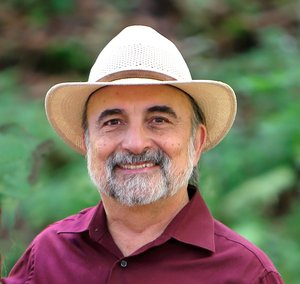
Suzanne simard and dr. teresa ryan
Mother Trees, Salmon and the Meaning of Reciprocity
How the work of Suzanne Simard and Dr. Teresa Ryan invites us to understand forests—and our place within them—through relationships.
Something carried from the ocean can become part of a tree.
In the coastal forests of British Columbia, this connection unfolds through the lives of salmon, bears, soil organisms and trees. Following that journey reveals relationships that reach beyond the boundaries we often draw between land and water, between species, and between human life and the rest of nature.
The work of forest ecologist Suzanne Simard and First Nations scientist Dr. Teresa Ryan has helped shape how we understand these relationships. At Universe Mindfulness, their insights inspire us to approach forests as living communities, and to ask what it means to receive their gifts while accepting responsibility for their care.
Suzanne Simard: bringing hidden relationships into view
Suzanne Simard’s decades of research have investigated relationships among trees and the mycorrhizal fungi associated with their roots. These fungi form intimate partnerships with plants, and their underground threads can connect the roots of different trees.
In a landmark study published in Nature in 1997, Simard and her colleagues used carbon isotope tracing to demonstrate carbon moving in both directions between paper birch and Douglas-fir under field conditions. Their work helped bring international attention to interactions occurring beneath the forest floor.
Through Finding the Mother Tree and When the Forest Breathes, Simard shares research alongside personal experience and her developing understanding of forest relationships. Her writing also considers how forestry practices might better support renewal, resilience and the generations of life that follow.
Her work has inspired us to see forests as intelligent, interconnected living communities. We use “intelligent” here to describe the perspective her work has opened for us. The extent and ecological significance of transfers through fungal networks remain active areas of scientific debate; recognising those questions is part of taking the research seriously.
For our guiding, the influence is practical: we invite participants to become curious about relationships they cannot immediately see, and to recognise that the tree before them belongs to a much wider community.
Dr. Teresa Ryan: science, culture and responsibility
Dr. Teresa Ryan, whose name is Sm’hayetsk, is a Canadian First Nations scientist from the Tsimshian Nation. A fisheries and aquatic ecologist and Indigenous knowledge practitioner, she brings scientific training together with knowledge rooted in her people’s culture and passed down through generations.
Her contribution to the Mother Tree Project & Program reaches into its research directions, partnerships and values. As its First Nations Liaison, she helps ground the work in Indigenous perspectives and protocols. The project also credits her as an Indigenous knowledge reviewer and science advisor for Simard’s books.
Ryan’s work provides a direct connection between forests and salmon. Her research and the Salmon Forest Project examine relationships among salmon, forest ecosystems and Indigenous Peoples, bringing questions of ecological health together with the traditions and responsibilities of stewardship.
Her perspective gives us more to consider than interconnectedness alone. It brings forward the question of how people should live within those connections.
Reciprocity expressed through practice
In an interview with Bioneers, Ryan describes traditional tidal stone traps that allow fishers to select salmon while leaving others to continue upstream. She explains the importance of allowing large breeding fish to reach their spawning grounds, supporting future generations. She connects this practice with generosity and reciprocity: human harvesting is shaped around the continuation of life.
Ryan also explains that knowledge of salmon–forest relationships is carried in stories, histories and identity. She describes how colonialism has restricted the expression of Indigenous stewardship, making its renewal a matter of cultural continuity as well as ecological care. These are living knowledge systems, held and practised by particular peoples.
For us, the significance is profound. Reciprocity becomes visible in decisions about what to take, what to leave and what must be protected for the future.
Her insights have helped us understand the forest as home. When we receive nourishment, shelter and a sense of wellbeing from it, we should also care for it in return.
That is our reflection on what we are learning. We acknowledge Ryan’s particular cultural and scientific perspective without treating it as a single viewpoint shared by all First Nations.
The salmon’s journey into the forest
Along the Pacific coast, salmon returning from the ocean carry nutrients accumulated during their lives at sea into freshwater systems.
Bears catch salmon and carry some into the surrounding forest to eat. Uneaten remains become available to scavengers and decomposers. As those remains break down, nutrients enter the soil and become available to plants. Researchers studying coastal British Columbia have documented this movement of marine-derived nutrients into forest ecosystems.
One particularly striking line of evidence comes from the wood itself.
In a 2013 study at a salmon-bearing watershed in Haida Gwaii, Thomas Reimchen and Caroline Fox examined Sitka spruce growth and nitrogen isotope patterns. They found that the nitrogen signatures in tree rings closely followed the distribution of salmon carcasses carried into the forest by bears. Tree growth was greatest in the area with the highest carcass abundance, although temperature and location also influenced the results.
By examining the balance of different forms of nitrogen, scientists can investigate the contribution of marine nutrients to trees. The forest holds a material connection to lives spent in the ocean.
Something carried from the ocean becomes part of a tree.
The forest also supports the salmon
The relationship continues in the other direction.
Trees and vegetation beside streams provide shade and help maintain suitable habitat for salmon. Wood entering waterways can also shape channels and create pools. NOAA research on wood restoration has documented changes including deeper, more frequent pools and the development of floodplain channels—features that contribute to the complexity of river habitat.
Ocean, river and forest are connected through these exchanges. Their boundaries are crossed by migrating fish, feeding animals, flowing water and the movement of nutrients.
The bear is feeding itself. Yet the consequences of that meal extend far beyond the bear.
For us, that is one of the most moving aspects of the story: an individual life participates in relationships whose effects reach well beyond its immediate activity.
Understanding can deepen wonder
Learning something of how these processes happen deepens our sense of wonder.
Knowing that researchers can detect a salmon’s contribution within a tree makes the connection more tangible. It gives scientific detail to a relationship we might otherwise appreciate only through imagination.
There is room here for a sense of the sacred: reverence for the complexity of life, and humility about how much we still have to understand. We do not need to establish a hidden intention behind the cycle to be moved by it.
When we contemplate these relationships, we feel part of something whose depth we cannot fully comprehend. That feeling brings us back to our own presence within the living world.
Our actions also have consequences beyond ourselves.
Bringing reciprocity into forest therapy
For us, these insights open a wider purpose for forest therapy.
We can invite people to notice what the forest offers them: calm, sensory richness, companionship, perspective or a renewed sense of belonging. We can also help them become attentive to the conditions that allow the forest itself to flourish.
Gratitude can become the beginning of that attention. Stewardship gives it practical expression.
The appropriate response may involve protecting a local woodland, supporting Indigenous-led conservation, joining a habitat restoration project or learning how everyday choices affect forests and waterways. Care becomes more meaningful when it responds to the needs of a particular place and the knowledge of those who understand it.
We believe that participating in such care may also deepen our next encounter with the forest. We return with a relationship that has continued between visits—with the knowledge that we have begun to contribute to the future of a place that contributes to our lives.
That is the invitation we bring into our guiding:
To receive with gratitude, and to let that gratitude become care.